By Adrian Huber, CEO of Corient, a B2B marketing agency in Sydney. The sequence in this article is the one we deploy, shown in full, because a template you can copy is worth more than advice you have to trust.
Almost everyone searching for lead nurture wants the same two things: an example sequence that actually works, and the answer to how many emails before it becomes harassment. Most of what ranks gives neither, just definitions of nurturing and a stock photo of a funnel.
Here is the sequence, email by email, with the timing and the job of each message. Then the harder part nobody writes about: who the sequence is really for, which is not the person receiving it.
Key takeaways
- Five emails across roughly two weeks, each with exactly one job: deliver, prove, show the mechanism, kill the objection, ask.
- Companies that excel at lead nurturing generate 50% more sales-ready leads at 33% lower cost per lead (Forrester Research). Structure, not copywriting, is what separates them.
- It takes an average of eight touches to earn a first meeting, and 44% of sellers stop after one follow-up. The gap is the opportunity.
- The best-performing asset in long-cycle B2B is not an email at all: it is the one-page document your contact forwards to the person who actually decides.
What does a working lead nurture sequence example look like?
Five emails, spaced 0, 3, 6, 9 and 12 days from the opt-in, compressing when someone shows active interest. This is the architecture we build variants of, and each email exists to move the reader one specific step.
Email 1, day 0: deliver. The resource they asked for, linked in the first sentence. One line on who you are. One line on what is coming. Sent from a person with a real name who reads replies. Welcome emails average an 83.63% open rate in GetResponse's benchmark data, roughly double a normal newsletter, because they arrive at the moment of maximum attention; wasting that slot on "thanks for subscribing" is the most common mistake in the channel.
Email 2, day 3: prove. One customer story as a tight before-and-after. Not a case study with a methodology section. "The team was losing 14 hours a week to manual reporting; it is now 2." Precision converts because precise numbers feel observed rather than manufactured. Soft close: the full story, or more examples on request. No demo ask yet.
Email 3, day 6: show the mechanism. The email that separates sequences that convert from sequences that merely educate. Pick one workflow and explain exactly how the problem gets solved: before-state, action, after-state. This one can run 400 to 500 words because genuinely evaluating readers will read all of it, and the drop-off from everyone else is useful signal, not failure. First demo offer, quietly: "If you want to see how this works for a team like yours, 20 minutes."
Email 4, day 9: kill the objection. Name the most common hesitation out loud, validate it, then show what it looks like in practice. Hiding from the objection does not make the committee forget it; it just means the objection gets discussed without you.
Email 5, day 12: ask. Plain and finite: you downloaded the thing, here is what I have sent since, if it is relevant I would like 20 minutes, and if the timing is off I will stop emailing. "Worth 20 minutes?" outperforms cleverness.
The cadence is a default, not a rule. A lead who clicks through email 2 to the case study is researching right now, so email 3 goes the next day, not in three. Every mainstream platform supports these behaviour triggers, and using them matters more than any subject line decision you will make.
Does the structure actually move numbers?
The aggregate evidence says yes, and by margins that justify the effort.
Forrester Research found that companies that excel at lead nurturing generate 50% more sales-ready leads at 33% lower cost per lead. The mechanism is exactly the structure above: when each email has a distinct job, the sequence keeps generating new information about who is evaluating, instead of repeating one message until people unsubscribe.
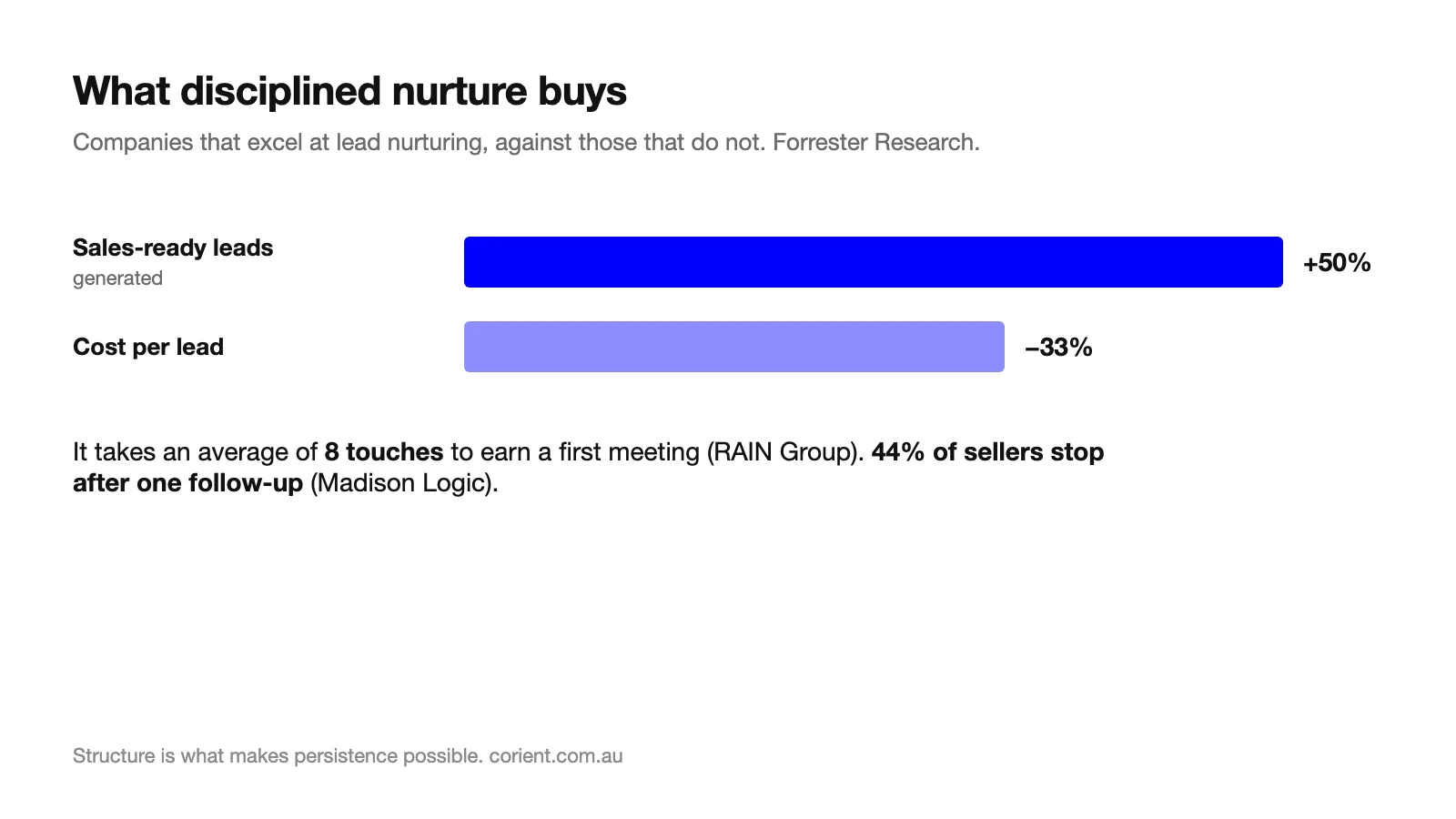
The persistence data points the same direction. It takes an average of eight touchpoints to earn an initial meeting with a new prospect (RAIN Group), while 44% of sellers stop after one follow-up. Stopping at email 2 abandons the majority of the sequence's value before it exists. And the payoff for holding on is not marginal: nurtured leads make 47% larger purchases than un-nurtured ones. Structure is what makes persistence possible: five emails with five different jobs is a sequence, five reminders is harassment.
Who is the sequence actually for?
Not the person receiving it. In considered B2B, buying committees on deals over $50,000 now average 11.2 stakeholders, buyers spend only about 17% of the journey talking to vendors at all, and 74% of buying teams report unhealthy internal conflict during the decision. Your emails reach one person. The decision happens in rooms that person attends without you.
So the highest-leverage asset in the whole programme is not in the five emails above. It is the forwardable: one page your contact can send to a sceptical CFO that survives being read without you there. The problem in the buyer's language, what changes if it is solved, cost as a range, what it takes from their team, what happens if they do nothing, and the awkward parts included on purpose, because a document with no downsides reads as marketing and gets discounted whole. One page, not a deck, because a deck needs presenting and the entire point is that it travels alone. Send it around email 3 or 4. It will do more work than the rest of the sequence combined, and it is the cheapest asset on this page to produce.
What do you send when nobody replies?
Not a check-in. "Just checking in" asks the reader to do your work and offers nothing, which is why it is the lowest-replying email in the channel.
Three moves that outperform it. A pattern-break note that is deliberately the shortest email in the sequence: one sentence of context, one direct question, no links, no branding, written like a human took 60 seconds. A piece of standalone value, something they can use whether or not they ever buy. And at the end of the line, the honest exit, where a subject line like "Should I stop sending you emails?" tends to outperform urgency-based alternatives, because it is the only message in their inbox not asking for something. Trigger re-engagement behaviourally, after three or four consecutive unopened sends or about 30 to 45 days of silence, rather than on a calendar.
Then stop, genuinely. Park cold leads on a quarterly, no-pressure list. In a market where mid-market cycles run about 121 days, this year's dead lead is routinely next year's enquiry, unless you spent the year teaching them to ignore you.
How does this connect to the rest of the system?
A sequence is the visible part of three quieter dependencies. Scoring decides who gets sales attention instead of automation, and the setup is in our Salesforce lead scoring guide. Personalisation decides relevance at scale, covered in using AI to personalise email campaigns. And email alone reaches one committee member, so pair it with retargeting so the rest of the room keeps encountering the company outside the roughly 17% of the journey buyers spend with any supplier at all.
One honest boundary from our own work: for FixZa we ran a 30-day nurture in GoHighLevel from first click to job-ready, alongside Meta demand generation, and it produced 100 leads in 30 days. That worked because the buyer was a homeowner deciding alone on a short cycle. Port the same 30-day shape onto an 11-person committee running a four-month evaluation and the sequence goes silent at exactly the moment the internal argument starts. Match the sequence length to the decision, not to the template you copied, including this one.
Frequently asked questions
How many emails should a B2B nurture sequence have?
Five over about two weeks for a specific opt-in, with behaviour triggers compressing the gaps for active readers, and a slower long-tail after that. It takes around eight touchpoints on average to earn a first meeting, so sequences that stop at two or three quit before the conversion window opens.
What should each nurture email contain?
One job each: deliver the promised resource, prove with one specific before-and-after, show the mechanism of how the problem gets solved, name and answer the main objection, then make a plain, finite ask. An email trying to do two of those jobs does neither.
What is a good open rate for lead nurture emails?
Welcome emails average 83.63% opens in GetResponse's benchmark data, newsletters around 40%, and later sequence emails typically land between those. But privacy changes have inflated opens, so judge the sequence on click-through, reply rate and sequence-to-meeting rate; a healthy problem-aware segment runs above 4% clicks and 1.5% replies.
What is a lead nurture email example that converts?
The mechanism email: pick one workflow, show the before-state, the action and the after-state with real numbers, and end with a 20-minute offer. It is the email that separates sequences that convert from sequences that merely educate, because it is the only one that shows the change rather than claiming it.
How long should you nurture a lead before giving up?
Through two full phases of no meaningful action, then move them to a quarterly low-pressure list rather than deleting them. With mid-market cycles averaging around 121 days, going quiet permanently is premature, and continuing weekly sends to someone ignoring you is how you buy your way into their spam filter.
Should nurture emails come from a person or the company?
A named person who reads replies. Half the sequence's mechanisms, the check-in, the objection email, the honest exit, only work because a human appears to be on the other end, and "noreply@" announces that nobody is.
What is the difference between lead nurturing and a newsletter?
A newsletter maintains attention; a nurture sequence moves a specific person toward a specific decision, one step per email. If your "nurture" has no progression, no objection handling and no ask, it is a newsletter, and it will produce newsletter results regardless of open rate.
Corient builds lifecycle systems for founder-led businesses in Sydney. If your sequence is educating people who never book, book a call or see how we have built it elsewhere.