Have you ever wondered why your emails are not getting opened, even when you know your offer is valuable?
We speak to so many business owners across Australia who feel stuck with email marketing. You spend time writing emails, setting up campaigns, and still see low open rates and barely any clicks. It is frustrating, especially when you know your service can genuinely help people.
The truth is, most emails today feel generic. They are sent to everyone in the same way, at the same time, with the same message. That is where things start to fall apart.
This is exactly why we have been helping businesses shift towards smarter systems using AI email marketing. Instead of sending the same message to everyone, AI allows you to personalise your emails at scale, making each message feel relevant and timely.
If you have been curious about how to make your emails actually connect with people, this guide will walk you through it in a simple and practical way.
What is AI Email Marketing?
AI email marketing is the use of artificial intelligence to automate, personalise, and optimise email campaigns based on customer behaviour, preferences, and data.
It typically includes:
- Behaviour-based email triggers
- Personalised subject lines and content
- Automated email sequences
- Predictive send times
- Data-driven campaign optimisation
In simple terms, it helps you send the right message to the right person at the right time.
How Can AI Be Used to Personalise Email Marketing Campaigns?
AI can be used to personalise email marketing campaigns by analysing customer data and behaviour to deliver highly relevant content to each individual at the right time. Instead of sending one generic email to your entire list, AI segments your audience based on factors like past interactions, interests, and engagement history. It can automatically trigger emails when someone takes a specific action, such as visiting a page, downloading a resource, or abandoning a form.
AI also helps create dynamic content, meaning different people see different versions of the same email based on what is most relevant to them. It can even predict the best time to send emails to each person, increasing the chances they will open and engage. Over time, these systems learn from results and continuously improve performance. For service businesses, this means more meaningful communication, stronger relationships, and higher conversion rates without needing to manually manage every detail. That is the real advantage of using ai email marketing.
Why Personalisation Matters in Email Marketing
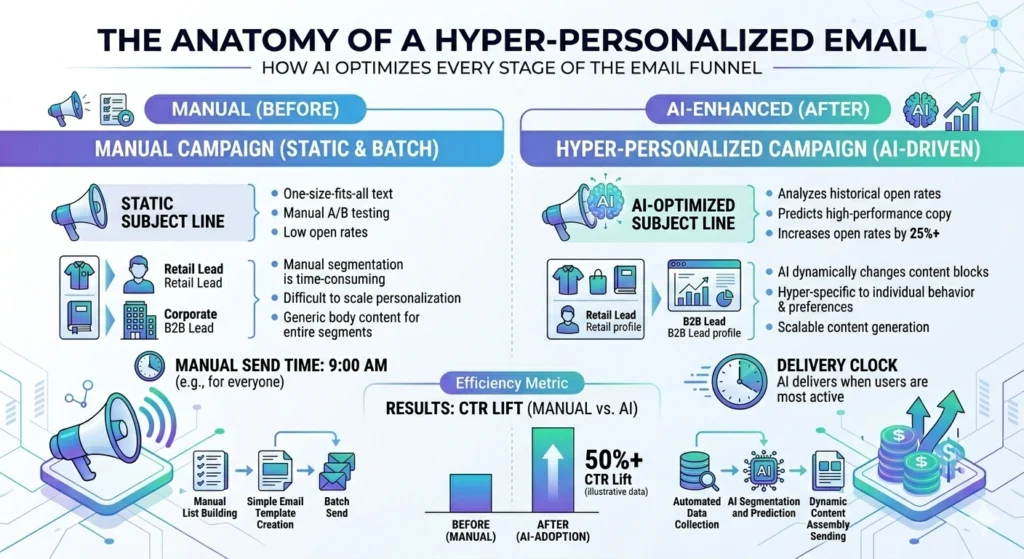
Australian audiences are becoming more selective with what they engage with online. People are receiving dozens of emails every day, and most of them get ignored.
If your emails are not relevant, they simply will not be opened.
Personalisation matters because:
- People expect content that feels tailored to them
- Generic emails are easy to ignore
- Trust is built through relevant communication
- Competition in inboxes is increasing
When your emails feel personal, they stand out. They feel more like a conversation and less like a broadcast.
Key Benefits of AI Email Marketing
Higher Open Rates
One of the biggest challenges with email marketing is getting people to actually open your emails. With AI email marketing, this becomes much easier.
AI analyses past behaviour, such as when a person usually checks their emails and what type of subject lines they respond to. It then uses this data to send emails at the right time and craft subject lines that are more likely to grab attention.
Instead of guessing what might work, you are using real data to improve your chances of getting noticed in a crowded inbox.
Better Click Through Rates
Getting an email opened is only the first step. What really matters is whether people take action.
AI helps improve click-through rates by making sure the content inside your emails is relevant to each reader. For example, if someone has shown interest in a specific service, your email can highlight that exact offering instead of something generic.
This level of relevance makes it easier for readers to engage, click, and move closer to becoming a customer.
Stronger Customer Relationships
When emails feel personalised, they build trust.
Instead of receiving mass messages that feel like they were sent to thousands of people, your audience receives content that feels like it was written just for them. This creates a more genuine connection.
Over time, this consistency builds stronger relationships, which is especially important for service businesses where trust plays a big role in decision-making.
Reduced Manual Work
Manually managing email campaigns can take a lot of time. Writing emails, scheduling them, segmenting lists, and following up with leads can quickly become overwhelming.
With AI, much of this work is automated. Once your systems are set up, they continue running in the background, sending emails, updating segments, and tracking engagement.
This allows you to focus on strategy and growth instead of getting stuck in day-to-day tasks.
Improved Campaign Performance
One of the most powerful aspects of AI email marketing is its ability to learn and improve over time.
AI tools continuously analyse how your campaigns perform. They look at open rates, clicks, conversions, and other metrics to identify patterns.
Based on this data, they can suggest improvements or automatically adjust elements like timing, content, or audience targeting. This means your campaigns become more effective the longer you use them.
How AI Personalises Email Campaigns
Behaviour-Based Segmentation
AI groups your audience based on what they actually do, not just who they are.
Instead of basic segments like age or location, AI looks at actions such as website visits, email clicks, downloads, and past purchases. This creates more accurate and meaningful segments.
For example, someone who has visited your pricing page multiple times can receive different emails compared to someone who just signed up.
Dynamic Content
Dynamic content allows you to send one email that shows different content to different people.
For instance, one subscriber might see a section promoting a specific service, while another sees a completely different offer based on their interests. This happens automatically within the same campaign.
This makes your emails feel highly personalised without needing to create multiple versions manually.
Predictive Send Times
Not everyone checks their emails at the same time.
AI analyses when each subscriber is most likely to open emails and schedules delivery accordingly. Some people might receive your email in the morning, while others get it in the evening.
This simple adjustment can significantly increase engagement without changing your content.
Personalised Subject Lines
Subject lines are often the deciding factor in whether an email gets opened.
AI tools can generate subject lines tailored to individual preferences, based on past engagement. They can also test multiple variations and learn which ones perform best.
This removes much of the guesswork and helps you consistently improve your results.
Automated Customer Journeys
Instead of sending one-off emails, AI allows you to build complete journeys.
For example, when someone signs up, they might receive a welcome email, followed by helpful content, then a service offer, and later a reminder. Each step is triggered automatically based on their actions.
This creates a smooth and structured experience that guides leads towards becoming customers.
Common Use Cases for AI Email Marketing
Here are some practical ways service businesses are using AI email marketing today:
Use CaseExampleWelcome sequencesPersonalised onboarding emails that introduce your business and servicesAbandoned actionsFollow-up emails are sent when someone starts but does not complete an enquiryPromotionsSpecial offers tailored to what users have shown interest inRe engagementEmails designed to reconnect with inactive subscribersUpsellingSuggesting additional services based on previous interactions
These use cases are simple to implement and can deliver quick wins when set up correctly.
How to Get Started with AI Email Marketing
Step 1: Collect and organise your data
Start with the basics. Gather information about your subscribers, such as their email interactions, preferences, and any previous engagement with your business.
Even simple data can go a long way when used properly.
Step 2: Segment your audience
Divide your audience into smaller groups based on behaviour or interests.
For example:
- New subscribers
- Active leads
- Existing clients
- Inactive contacts
This allows you to send more relevant emails to each group.
Step 3: Choose AI email tools
Select tools that are easy to use and align with your needs.
Look for features like automation, segmentation, and AI-driven insights. Avoid overcomplicating your setup by using too many platforms at once.
Step 4: Create personalised workflows
Set up simple automation workflows that trigger emails based on actions.
Examples include:
- Welcome emails after sign-up
- Follow-ups after enquiries
- Reminder emails before appointments
Start small and expand as you become more comfortable.
Step 5: Test and optimise campaigns
AI works best when combined with ongoing improvement.
Track your results and look at what is working. Test different subject lines, content, and timing.
Over time, these small adjustments can lead to significant improvements in performance.

Best AI Email Marketing Tools in 2026
HubSpot
HubSpot offers a complete system that combines CRM, email marketing, and automation. Its AI features provide insights that help improve targeting and engagement.
ActiveCampaign
ActiveCampaign is known for its advanced automation and segmentation capabilities. It is ideal for businesses that want more control over their email workflows.
Mailchimp
Mailchimp remains a popular choice due to its ease of use. Its AI features help with content suggestions, timing, and audience insights.
Klaviyo
Klaviyo is strong in behaviour-based email marketing. It is especially useful for businesses that want detailed segmentation and personalisation.
ChatGPT
ChatGPT can assist with writing email content, generating ideas, and creating personalised messaging. It is a flexible tool that can support many parts of your email strategy.
What Corient Recommends
From our experience, the biggest shift that creates results is not sending more emails, but sending better ones.
We always recommend starting with segmentation. Even simple segments like new leads, active clients, and past customers can make a big difference. Once you have that in place, you can begin layering in more personalisation.
We also believe strongly in keeping your emails human. AI should support your messaging, not replace your voice. The goal is to make your emails feel more relevant and natural, not robotic.
Most importantly, focus on consistency. You do not need complex systems to get results. Start simple, test what works, and build from there. That is how AI email marketing becomes a real asset to your business.
FAQs
What is AI email marketing?
AI email marketing uses artificial intelligence to automate and personalise email campaigns based on user data and behaviour.
How does AI improve email personalisation?
AI analyses data to deliver tailored content, timing, and messaging for each individual.
Is AI email marketing suitable for small businesses?
Yes, it is one of the most effective ways for small businesses to scale communication.
What tools are best for AI email marketing?
Popular tools include HubSpot, ActiveCampaign, Mailchimp, and Klaviyo.
Final Thoughts
Email marketing is not going anywhere, but the way it works is changing.
If your emails still feel generic, you are missing an opportunity to connect with your audience in a meaningful way. Personalisation is no longer optional. It is expected.
The good news is that you do not need to overhaul everything overnight. With the right approach, AI email marketing can help you take small steps that lead to big improvements over time.
If you want to see how personalised email marketing could work for your business, we would love to help. Book a quick call with our team, and we will walk you through a simple, practical plan tailored to your goals.
Check out more articles below:
AI Marketing Automation in 2026: The Complete Guide for Service Businesses
15 ChatGPT Prompts for Marketing Automation That Actually Work
AI Tools Every Agency Should Use in 2026 to Stay Competitive