By Adrian Huber, CEO of Corient, a B2B marketing agency in Sydney. Pricing articles by agencies usually exist to make you call for a quote. This one exists to let you budget without calling anyone, which we have decided is better marketing.
Digital marketing in Sydney costs $2,500 to $40,000 a month in agency fees, most founder-led businesses should be planning around $3,500 to $10,000, and whatever retainer you agree to, your real monthly spend will land at roughly 1.5 to 2.5 times that figure once media, creative and tools are counted.
That is the answer to the question as searched. The rest is the part that actually protects your money: what each band buys, the four line items agencies leave out of the quote, the maths for a small budget, and the one thing that changed in 2026 that most proposals have not caught up with.
Key takeaways
- Sydney pricing bands: $1,500 to $3,000 buys one specialist discipline, $3,000 to $7,500 a small team with real ownership, $7,500 to $20,000 the full system, above $20,000 enterprise coordination.
- The quoted retainer is typically only 40 to 65% of true monthly cost. A $6,000 retainer is a $9,000 to $15,000 decision.
- Under about $2,000 to $3,000 a month total, skip the agency: fix conversion first, the returns are permanent and nobody invoices you monthly for them.
- Part of a 2026 budget now buys visibility inside AI assistants, which never appears in a ranking report, and we have first-party numbers showing why that matters.
How much does digital marketing cost in Sydney per month?
Across the proposals and rate cards we see in the Australian market, agencies charge roughly $2,500 to $40,000 a month on retainer, and the realistic band for a founder-led business wanting depth rather than token presence is $3,500 to $10,000. That range is our own read from the buying side of a lot of proposals, not a number lifted from anyone's pricing page. Sydney sits at the top of the national range, but the premium is a talent-cost difference of maybe 10 to 15%, not a different market.
What separates the bands is not talent, it is how much of the system one team can hold at once.
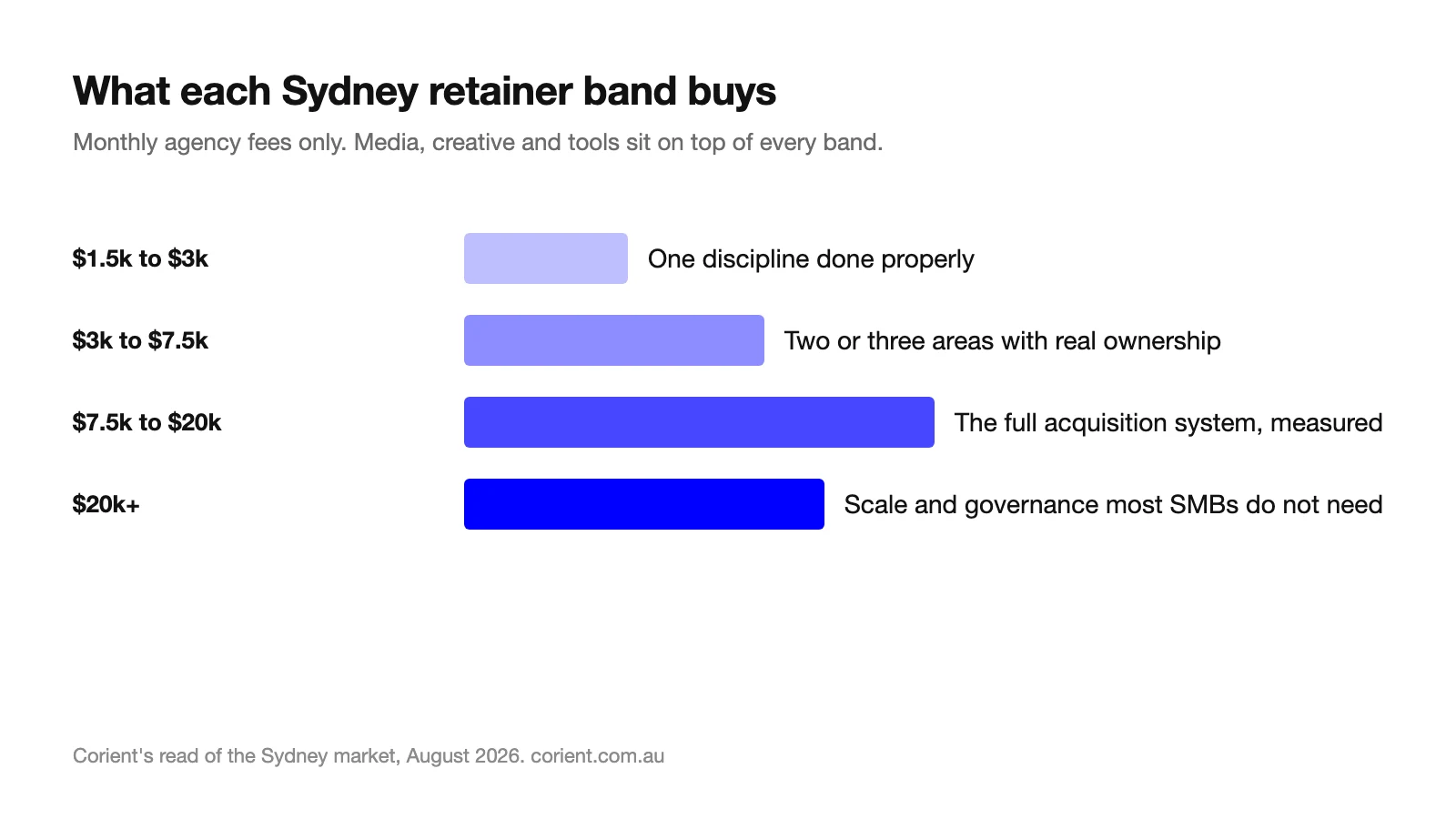
The cheap end deserves one honest paragraph. A few hundred dollars a month is not a smaller version of the same service; it is templates, automation, or one junior spread across twenty accounts. For a defined mechanical task that can be fine. As "full-service marketing" it is how the cheapest option becomes the most expensive, and a capable freelancer on a single brief nearly always beats it.
What does the quote leave out?
Four line items, and together they are the difference between the number you agreed to and the number you will actually spend. Full-cost accounting is not pedantry: businesses that count everything report their cost per lead runs 35 to 60% higher than the ad-spend-only version, which means a budget built on the quote alone is optimistic by a third before work begins.
Media spend. Almost never included, and it should be paid by you, on your own ad accounts, directly to the platforms. Not for tidiness: if the relationship ends, the account history and audiences are worth real money, and they should be yours to keep.
Creative production. Some volume is usually included; video rarely is, and video is what paid channels increasingly demand. Ask for the refresh cadence in the proposal, because paid social consumes creative every four to six weeks.
Tooling. CRM, automation, analytics, call tracking. A few hundred a month, occasionally much more, and it survives the agency relationship, so choose tools you would keep anyway.
Your own hours. The uninvoiced line. Several senior hours a week in the first quarter for approvals, information and decisions. More engagements die of client-side unavailability than of agency incompetence, and no line item warns you.
What can you do with a small budget?
Below roughly $2,000 to $3,000 a month all-in, do not hire an agency. This is not gatekeeping, it is arithmetic that even the forums where agencies get roasted agree on: at that level the fee eats the budget before anyone can learn anything.
The order of operations for a small budget is fixed and unglamorous. First, conversion: your website's visit-to-enquiry rate is the multiplier on every future dollar, it is cheap to fix, and the fix is permanent. Second, measurement: know where your last ten customers came from, even if the system is a spreadsheet. Third, one channel, funded to significance, rather than four channels funded to ambiguity. Splitting $2,000 across SEO, socials, email and ads buys four results too small to read, which is the most expensive form of tidiness there is.
When the budget grows past the floor, the sequencing question becomes paid versus SEO, and the honest answer is that they buy different things: paid buys an answer in six to eight weeks and stops when you stop; SEO takes six to twelve months and compounds afterwards. Buy information first, then compounding, which is the argument we make in full in why evidence-based marketing beats guesswork.
Which pricing model protects you?
Four exist in the Australian market. A flat retainer with media paid by you is the cleanest default: predictable, honest about scope, delivery risk on the agency. Pass-through adds convenience and a conflict, so require sight of the platform invoices. Percentage of spend, typically 10 to 20%, points the agency's incentive at spending more rather than spending well, and only makes sense at volumes where management genuinely scales with spend. Pay for performance reads as safest and usually costs the most per qualified opportunity, because the provider prices in their risk and chases the lead volume that flatters their invoice.
Whichever model, one structural question predicts the relationship better than any case study: where is account management funded from? Most retainers pay for strategy calls, reporting, QA and project management out of the same pool as delivery, which is why delivery quietly shrinks in busy months while the meetings survive. We structure it the other way, with management carried on top of delivery rather than inside it, and the full version of that question, along with the four others worth asking before you sign anything, is in is hiring a B2B marketing agency worth it.
What changed in 2026, and why part of your budget is now invisible?
A growing share of buyers now ask an AI assistant before they ever search, and that traffic behaves differently. Our own July analytics: visitors arriving from AI assistants engaged for 4 minutes 53 seconds on average against roughly 44 seconds from traditional organic search, about 6.6 times longer, with 4.3 times the on-site events per session.
The same month, a brand-visibility tool monitoring a fixed set of commercial prompts reported us absent from AI answers entirely. Both readings were accurate; they measure different things, one counts real referral sessions and the other counts inclusion in a sample of AI responses. A business reading only the tool concludes AI search produces nothing while highly engaged buyers quietly arrive; a business reading only analytics concludes it is winning while competitors own every commercial answer in the category. Demand both views in your reporting.
Method note: figures are from Corient's GA4 property for 1 to 31 July 2026. The comparison is average engagement time per session and events per session, AI-assistant referrals identified by referrer domain against organic search sessions in the same period. We publish the ratios rather than session counts.
The budget implication is smaller than the measurement one: this is mostly a change in how content is built (answer-first pages carrying information nobody else has) rather than a new line item. And when an agency tells you your domain is too small to matter in AI search, two current findings say otherwise: domain authority explains only about 3% of the variance in AI citation, and 88% of AI-mode citations come from pages outside the organic top ten. Small specialists can win answers they could never win rankings.
How do you compare two proposals?
Ignore the deliverables tables; they are written to be compared, which is exactly why they contain no information. Five questions decide it. Which single channel gets tested first, and what result ends the test either way? Where does account management sit, inside delivery or on top? Show me an actual month-two report, redacted. Who works on my account by name, and what else are they on? And which costs live outside this number? An agency that answers all five plainly is safe to hire at any of the bands above. Evasion on any of them is the answer, delivered early and free of charge.
Frequently asked questions
How much does a digital marketing agency cost per month in Sydney?
Between $2,500 and $40,000 in fees, with $3,500 to $10,000 the realistic band for a small or mid-sized business buying real depth, and Sydney sitting at the top of the national range. Plan total spend at 1.5 to 2.5 times the retainer once media, creative and tooling are included.
How much should a small business spend on digital marketing?
If the total available is under about $2,000 to $3,000 a month, spend it on website conversion and measurement rather than an agency, because below that floor fees consume the budget before results can be read. Above the floor, fund one channel to significance rather than four channels to ambiguity.
What is included in a digital marketing retainer?
Strategy, campaign management, an agreed content or creative volume, reporting and the named capability areas. Media spend, most video production and tool licences sit outside it, which is why the quoted fee is typically only 40 to 65% of true monthly cost.
Is SEO or paid advertising cheaper to start with?
Paid is cheaper to start and answers within six to eight weeks but stops when the spend stops; SEO needs six to twelve months and then compounds. For an unproven business, paid first, because the first purchase is information, then move winnings into SEO to hold the ground more cheaply.
Why do agency quotes for the same work vary so much?
Because they are quoting different products behind the same words: different seniority doing the work, different amounts of management, and different definitions of what a lead or a deliverable is. The five comparison questions above expose the difference faster than any deliverables table.
What should never be an extra charge?
Reporting, account management, strategy time and standard revisions belong inside the fee. Media, tools and major creative such as video are legitimately separate, and a proposal that discloses them up front is telling you something good about everything else it says.
How long before digital marketing pays for itself?
Leading indicators by month two, a commercially readable result by month four to six for considered B2B purchases, because mid-market sales cycles average around 121 days. A promise meaningfully faster than that usually means leads are being counted rather than revenue.
Corient builds acquisition systems for founder-led businesses in Sydney. If you want your budget run against the bands above before you sign anything, tell us about your business, or see how we work and what we have built.